© Ingrid Haunold
My rating: 3 (of 5) “stars”
Last year, I read three books written by Daniel Defoe: “Robinson Crusoe,” which was first published in 1719, and “Moll Flanders” and “A Journal of the Plague Year,” which were both published in 1722. Of those three books, I liked the “Journal” best.
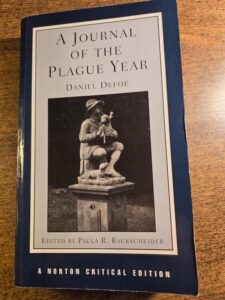
I bought a “Norton Critical Edition” of the book at my local bookstore in Vienna, Stöger-Leporello. The book was edited by Paula R. Backscheider, and published in 1992 by W. W. Norton & Company, Inc.
Critical editions of books provide textual criticism, and aim to recreate an author’s intent. In other words, those editions try to peek into the minds of deceased writers. What did he or she really try to say? Critical editions contain a lot of additional materials.
My Norton Critical Edition contains the authoritative text of the novel, background materials about the Plague of 1665 and the threat of another Plague in the years 1720-1721; articles by a number of writers which reflect on “Plagues” of all kinds (e.g., AIDS) and their effects; and about half a dozen scholarly articles about the novel (literary criticism).
Those additional materials make up half the pages of the book; the novel itself is heavily annotated with footnotes. I do think those texts added value to the book, even though I stopped reading the footnotes after a few pages. They were just too distracting.
The “Journal” is a fictional account of the Plague epidemic in London in 1665. When the book was first published, it was published with the following title: “A Journal of the Plague Year: Being Observations or Memorials, Of the most Remarkable Occurrences, As well Publick as Private, Which happened in London During the last Great Visitation in 1665.”
And that’s the story, in a nutshell.
I read the book in 2025, shortly after we all lived through the COVID pandemic. The similarities between the effects of the Plague in 1665 on the people of London, and the measures taken to contain the Plague, were reminiscent of all our experiences during the COVID pandemic. It felt utterly strange to read a book that was written more than 300 years ago, yet was so timely. I do recommend that you read the book, if only to compare your own experiences during the COVID pandemic with a fictional account of the Plague in 1665.
Why did I only award the book 3 out of 5 “stars?”
Daniel Defoe’s main weakness as a writer is, in my opinion, story structure. Defoe meanders, and repeats himself several times; he describes several similar anecdotes which leads to feelings of déjà-vu in the reader. Then, all of a sudden, he starts telling a story about the experiences of a band of travellers during the Plague, and for approximately twenty pages – that’s 10% of the novel’s length – I wondered, what the f… is happening here? All of a sudden I felt like I was reading a different book. The book’s a bit of a mess, really – but totally worth reading.